
Notes on post-Soviet sleeper trains and the people I rode them with

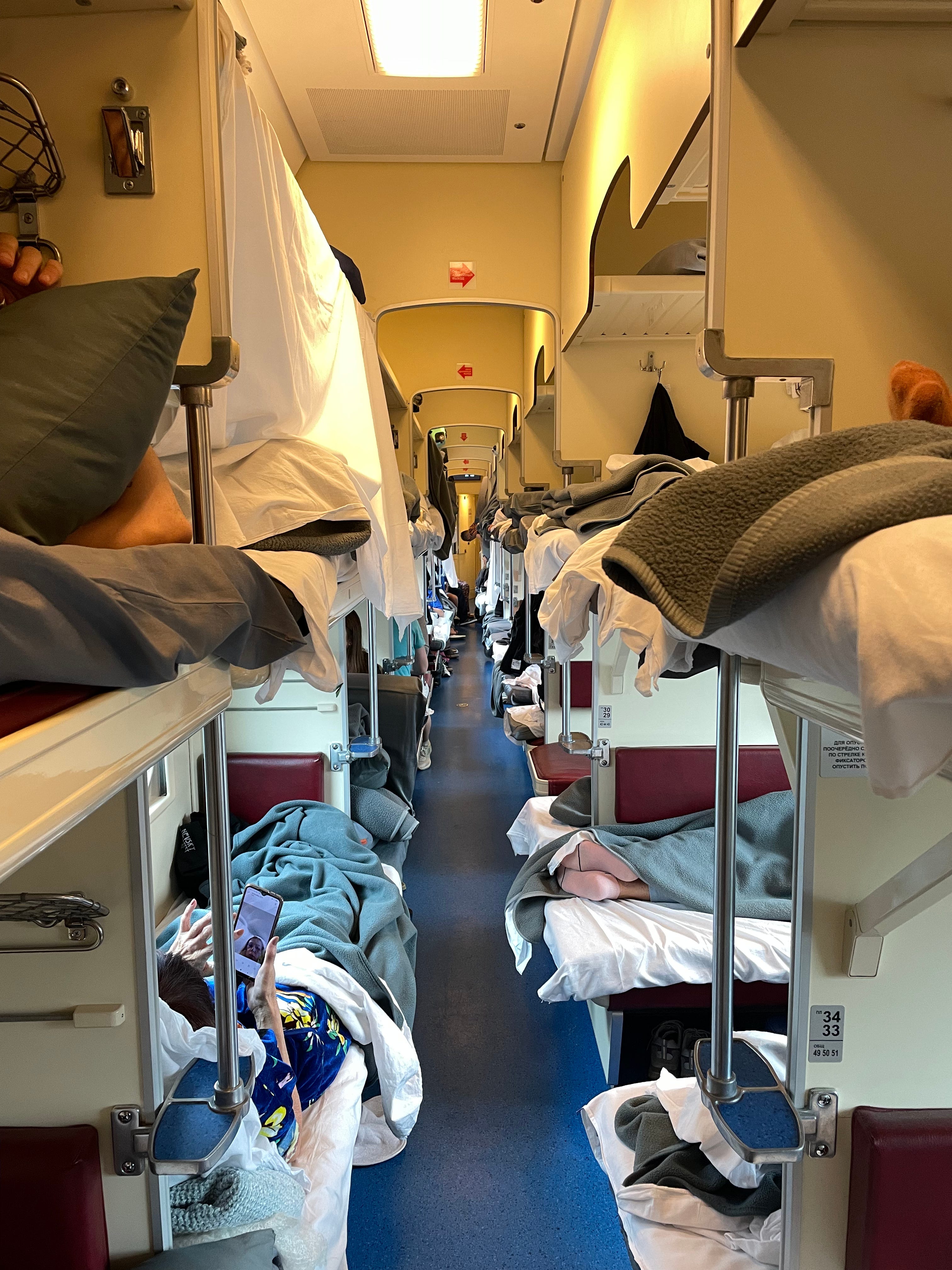
I first travelled on one of these in 2011 on an overnight journey from Moscow to Kyiv. My memories are snapshots: watching a portable DVD player in the top bunk, being shouted awake by guards for a passport check at the Russia-Ukraine border, and my dad opening a beer with the end of a toothbrush.
…
A big gap, then again in September 2021, when a group of fellow exchange students and I headed from the Russian capital to St Petersburg for the weekend. Our bunks were all in separate parts of the carriage, and we swapped grievances on WhatsApp about how hot we all were and whether it was culturally acceptable to ask to crack a window. “Russians hate drafts, so I wouldn’t," one friend warned. “I just managed to ascend my bunk, and now I need a bloody wee”, someone lamented, whilst another in our cohort suggested we perform a Mexican wave up the carriage and back. Such was the giggling that I’m surprised we weren’t thrown from the train by babushkas.
…
In the first days of 2023, my boyfriend, Abdi, and I embarked on the journey from Almaty, Kazakhstan’s largest city, to Shymkent, its third. The train carries you due west for between 10 and 14 hours, traversing nearly the entire length of neighbouring Kyrgyzstan to the south. We took extremely weird snacks to sustain us, including chicken strips from a Korean cafe, miniature tangerines, and a horrific drink Abdi loved called “Milkis” - a sort of thin, carbonated milk that I thought resembled gruel.
Our cabin mates on this journey were a student heading to visit her family in a far-flung corner of Kazakhstan’s west, and an Uzbek-Kazakh border guard with a torn meniscus. Noticing his stiffly bandaged leg, I proposed he take my bottom bunk, but he politely declined. As the four of us began to make friends, the carriage conductor entered our cabin and asked for Abdi by name. Abdi got up and followed the guard out of the cabin. “What did he want?” I asked anxiously when Abdi returned several minutes later. It turned out the conductor had noticed us kissing on the platform and deduced we were together, and was now offering the use of his own private cabin for the night for the price of 10,000 tenge (then about 20 quid). “I told him no because we have a nice company here,” Abdi said, gesturing to the student and border guard and smiling. Seeing my naive incredulity, he shrugged and said, “people have to make a living somehow, Ailis”.
After learning that neither of our cabin mates had ever heard of James Bond, I insisted upon a group screening of Casino Royale, which I had downloaded on my laptop. Abdi, the student and I sat side by side on the bottom bunk, while the Uzbek-Kazakh border guard stretched out on his bed above us. He kept swearing loudly in Russian during the fight scenes.
….
Retracing the Almaty-Shymkent route in reverse that summer, I shared a cabin with a Kazakh mother and her two young sons, one of whom had adorably chubby cheeks and shyly poured me a plastic cup of iced tea after being prompted to by his mother. They shared their picnic with me, which thankfully did not include Milkis or Korean fast food. On the platform in Almaty the next morning, Abdi solemnly shook hands with the two boys to thank them for looking after me throughout the night.
…
The Marathon: Moscow - Novorossiysk
Russia, October 2023. Travelling 1,500 km from Moscow down to Novorossiysk on the Black Sea, Russia’s largest port and city where Abdi grew up. We’ve been invited to a wedding there.
The journey cost around 3,000 roubles (then £30) and took 30 hours. You board the train at midnight, go to bed, get up, spend the day on board, go to bed, arrive early the next morning. Living for a day and two nights in a crowded, moving building a yard wide has its challenges. If you’re not asleep, you’re either standing, constantly in everybody’s way, or sitting down on a bed, where you feel trapped and restless Naturally, about 29 of the 30 hours on board tend to be spent in the restaurant car.
This particular route down into Russia’s deep southwest takes you within pretty hairy proximity to Ukraine’s eastern border and the active conflict zones of the ongoing war. The train also stops in the city of Rostov-on-Don, which in June 2023 essentially became the site of a coup launched by the mercenary Wagner Group leader, Yevgenii Prigozhin, against Russia’s defence ministry. Tanks rolled in (one got itself wedged in the entrance to the local circus), armed paramilitaries roamed the streets, and others ate Big Macs in the Rostov McDonald’s.
Fast forward four months to October, and the coup attempt had failed, Prigozhin had been blown up in his own plane, and the Wagner mercenaries had been offered safe refuge in Belarus or contracts with the Russian army proper (decent options considering most of them had been recruited to the front from prison).
Some were clearly still doing their own thing, however, as they were sitting a few booths along from us in the restaurant car.
Abdi and I had made friends with the people at the table across from us who worked for a sex toy company and were heading back home after attending an exhibition of dildos in Moscow (truly). They kept buying us bottles of Stella Artois (which obviously you can get on board a train crossing a country at war and under heavy western sanctions) and declared Russia to be “the freest nation in Europe”. “There are three independent countries in the world”, the most vocal of them declared, “Russia, China and North Korea”. When I asked whether he thought Russia was free for gay people, the same man declared that he would “destroy them all”. Everyone in the carriage looked round at us, and I found myself thinking that I would literally rather be sat with the paramilitaries. Naturally, we got a group photo.
I could only catch snatches of the soldiers’ conversation, but they were drinking a lot of vodka and their loud voices carried down the carriage. “We held the position,” one declared fiercely to the table at large, as he swigged down a glass. “Glory to Bakhmut, glory to Russia”, another said into his phone, “Prigozhin is our father”.
“If you don’t want to go back, why don’t I break your leg?” one said to another who had his head on his arms. He was alluding to an old trick in Russia where men of fighting age deliberately snap each other’s limbs to buy themselves a few extra months away from the frontlines.
Seeing me watching, two guys in the booth behind calmly advised we don’t pay the soldiers any attention. A couple of tourists from Delhi on our other side looked bemused. One asked me (as the only English speaker) for tips for what to see in Novorossiysk.
It was beyond surreal. I found it incredible that the Wagner fighters could be speaking the same Russian as we were, using the same words, like we had something in common.
Another thing we all had in common was a strong craving for nicotine. These proved a challenge to satisfy, however. Usually, the sleeper trains stop for at least 10 minutes or so at every station, sometimes for up to half an hour, even, giving passengers time to mill around on the platform. The driver of our locomotive must have been on a very tight schedule, however, as we had a mere two minutes at each stop. Every time the train slowed to a standstill the whole restaurant car would scramble to its feet - soldiers, sex toy makers, tourists and wedding goers - and, laughing hysterically, make a mad dash along the gangway to the open door of the carriage. As we were all quite drunk we just could not get the timing right, and kept getting shouted at by the train conductor to get back on board as we frantically attempted to disembark, cigarettes clamped between lips.
…


After the wedding, Abdi was staying in Russia for a while to have his tonsils out, but I was to continue south, to Georgia, via the land border crossing at Vladikavkaz in Russia’s republic of North Ossetia.
It was 31 October 2023. I boarded wagon 7 of the train and found my way to my bottom-level bunk. Within minutes, every bed around me had been occupied by a member of the Russian army. Each soldier had two tapes on his chest, one that read ВОРУЖЕННЫЕ СИЛЫ РОССИИ (Voruzhenie Siliy Rossii - Russian Armed Forces), and the other bearing each individual’s name, formatted as SURNAME, FIRST NAME INITIAL. PATRONYMIC INITIAL.
The soldier whose bunk was above mine made up his bed, stowed away all his Russian Army branded bags and kit, and then sat down next to me, keeping his distance.
He sat in just a beige, army-issue, short sleeve t-shirt (the soviet-era sleeper trains are reliably sweltering), but his grey, fluffy ushanka hat remained in place. He was young, maybe my age, remnants of teenage acne blemished his otherwise smooth face, which he never once turned fully to face mine.
Other soldiers, many of them older-looking, were soon moving off to the toilets at either end of the carriage to change into loungewear for sleeping, and returned with their uniforms on hangers, which they placed on hooks by each bunk.
They were evidently very used to this, I observed. The routine, moving around a lot by train, from A to B. The changing, the luggage, the transition from soldier to civilian, but never quite fully getting there, the insignia on even their pyjamas constantly reminded them that they had signed up to kill and perhaps be killed.
Sitting on my bunk, knees pulled into my chest, I thought about how oddly intimate this was. Like witnessing an army behind the scenes the part you don’t really think about or ever see, until you end up literally in bed with the reality of it - sleeping feet apart, hearing them breathe in the night, brushing our teeth in the same steel sink.
The ushanka-wearing soldier next to me was soon up again to go to the samovar at the end of the carriage and fill his box of instant noodles with boiling water. He walked back slowly, carrying the Styrofoam box by two of its corners, careful not to spill a drop.
In an effort to make conversation (we’d be sharing the same 5 square metres for the next 14 hours) I asked timidly whether he preferred the brand of noodles he was eating, Rolton, or the nation’s favourite, Doshirak.
Rolton, he said.
I agreed, and an earnest discussion ensued between us as to the reasons behind our preference. His fellows looked over curiously; some joined in the conversation, though seemed unsure as to whether they should talk to me directly.
A soldier across from us was lying on his top bunk drinking an energy drink, still in his Armiya Rossii uniform. The noodles-eating soldier told me that usually they weren’t allowed to lie down between 6am and 10pm - “это самое тупое что можно делать” (“that is the stupidest thing you can do”) - and it was only because their commanding officer had come and given the go-ahead that they were free to recline now. He also told me how every night in the barracks they would assemble in their boxers to have their bodies checked for bruises – evidence they had been sparring amongst themselves.
“No fighting allowed, only with the opponent. Some violence is good, some bad,” said the noodles soldier.
The boys got off the train at each stop to smoke on the platform, night falling around them, in their matching standard-issue lounge wear and Russian army flip-flops.
How many of them will be dead by winter, I wondered, as we crawled still further south.
When I awoke at dawn somewhere near Pyatigorsk, the soldiers were gone.